Joseph Stalin
A Gentleman in MoscowJoseph Stalin stands in the novel as both architect of a sweeping state transformation and the absent center of a succession crisis. His death on March 3, 1953, ends an era without settling who will rule next; the millions who queue to mourn him register not one uniform allegiance but a tangle of gratitude, loss, and fear of what comes after.
Political Power and Historical Turning Points
The novel introduces Stalin through the historian’s retrospective habit of naming decisive dates. Its narrator places the launch of the First Five-Year Plan on January 3, 1928, alongside the drafting of Article 58 and the political defeat of Nikolai Bukharin. Stalin outmaneuvers Bukharin, described as a defender of the peasant, and removes him from the Politburo on November 17, 1929. The sequence presents the purge of political opposition not as an isolated maneuver but as a turning point that clears the way for a return to autocracy in all but name.
The date-making itself carries an edge of irony. Historians can point from the safety of hindsight to a day, an hour, or a bend in the river and call it decisive; the people living through history do not possess that certainty. Stalin’s rise is therefore framed both as a concrete political change and as one of the episodes later generations will use to explain how a country’s course was altered. The narrator’s image of Article 58 as a net that would eventually ensnare everyone widens the significance of these events beyond the fate of one defeated rival.
Industrial Ambition and Agricultural Cost
The First Five-Year Plan is associated with the project of converting an agrarian Russia into an industrial power. Tens of thousands of urban workers build power stations, steel mills, and heavy-machinery plants, while agricultural regions are expected to supply the increased demand for bread. The national plan thus links factory production to the countryside: industrial ambition depends on grain extracted from the people who grow it.
The account traces the consequences through a chain of pressures rather than presenting agricultural collapse as a single accident. A million kulaks are exiled to clear the way for the campaign, even though they are described as the regions’ most capable farmers. Peasants resent and distrust the new agricultural methods; tractors, meant to usher in a new era, are scarce; and adverse weather contributes to a collapse in output. Yet the imperative of feeding the cities brings higher quotas and requisitions enforced at gunpoint. In 1932, the combined pressures produce widespread hardship in the agricultural provinces and starvation deaths for millions of peasants in Ukraine.
Stalin’s place in this account is bound to the political project and its consequences, but the narration describes the machinery of policy in collective and administrative terms. That choice gives the campaign a chilling scale: decisions made in the name of national transformation become quotas, requisitions, shortages, and hunger in particular regions. The plan’s promised leap into industrial modernity is set against the destruction and deprivation imposed on rural communities.
Death and Public Mourning
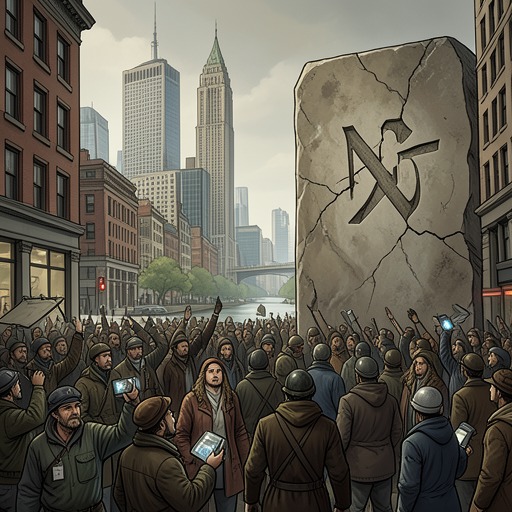
Stalin dies in his Kuntsevo residence in the aftermath of a stroke on March 3, 1953. The novel notes the many names by which he was known—Dear Father, Vozhd, Koba, Soso, and Stalin—making the public figure feel at once singular and multiplied by the different forms of address attached to his rule. His death is followed immediately by public ceremony. Workmen and trucks laden with flowers arrive at the Palace of Unions on Theatre Square, and within hours a portrait three stories high covers the building’s facade.
The funeral rituals grow into a spectacle of mass attendance. On March 6, Harrison Salisbury, the new Moscow bureau chief of The New York Times, watches from the Count’s former rooms, then occupied by the Mexican chargé d’affaires, as Presidium members arrive in ZIM limousines and the coffin is borne inside from a bright blue ambulance. When the Palace of Unions opens to the public the next day, the line of citizens waiting to pay their respects stretches five miles across the city. The scale of the queue invites Western observers to ask why so many people would wait to see the body of a tyrant.
The narration refuses to reduce the mourners to gullibility or compulsion. Some grieve for the leader who brought victory in the Great Patriotic War; others mourn the man they credit with driving Russia toward world-power status. Still others weep because his death makes a new and uncertain era visible. These motives coexist in the line, complicating any simple division between private grief and political spectacle. The funeral’s immense attendance reveals how thoroughly Stalin’s rule had become entangled with both national achievement and the citizens’ understanding of their future.
The Succession Crisis
Stalin leaves no succession plan and no obvious heir. The novel lists eight men with plausible claims to leadership: Beria, Bulganin, Malenkov, Mikoyan, Molotov, Kaganovich, Voroshilov, and Nikita Khrushchev. The list turns the question of succession into a problem of competing centers of authority rather than a smooth transfer from one ruler to another.
In the immediate aftermath, Malenkov appears most likely to prevail. Identified as a progressive internationalist and an outspoken critic of nuclear arms, he holds both the premiership and the post of General Secretary of the Central Committee, a combination that echoes Stalin’s concentration of power. The Party’s upper ranks soon reach a contrary consensus: no one person should again hold both offices. Ten days after Stalin’s death, Malenkov is forced to pass his chairmanship of the Secretariat to Khrushchev. The resulting duumvirate balances two antagonists with contrary views and ambiguous alliances, leaving the world to watch an unsettled contest rather than the emergence of a clear successor.
Narrative Significance
Stalin is less a continuously present character than the organizing force behind political events that reach into private and everyday life. The novel moves from the distant perspective of historical dates to the material signs of rule: fields, grain quotas, factories, files, portraits, limousines, and a five-mile funeral line. Its contrasts are pointed. Industrial expansion proceeds alongside rural starvation; the funeral honors a leader whom the same account identifies as a tyrant; and a state built around concentrated authority must improvise once its central figure is gone.
The treatment also measures power by its effects on what people can know and anticipate. The campaign’s official purpose is national development, but local conditions—resentment, missing tractors, weather, and falling harvests—do not conform to the plan, while requisitions continue regardless. After Stalin’s death, the absence of an agreed successor turns the apparent permanence of his rule into uncertainty. His decisive significance lies in this double legacy: the immense transformation pursued in his name and the instability revealed when the man at its center can no longer command the future.